
Fewer cars, fewer collections: Montreal’s waste management paradox
When the ecological transition requires citizens to travel… with the very vehicle we want to reduce
Montreal wants to reduce greenhouse gases, encourage walking, cycling, public transit and pedestrianization, and reduce dependence on the automobile. From a climate perspective, this direction is necessary. Road transport remains one of the major levers for reducing emissions in urban areas, and the city is right to want to transform its mobility habits.
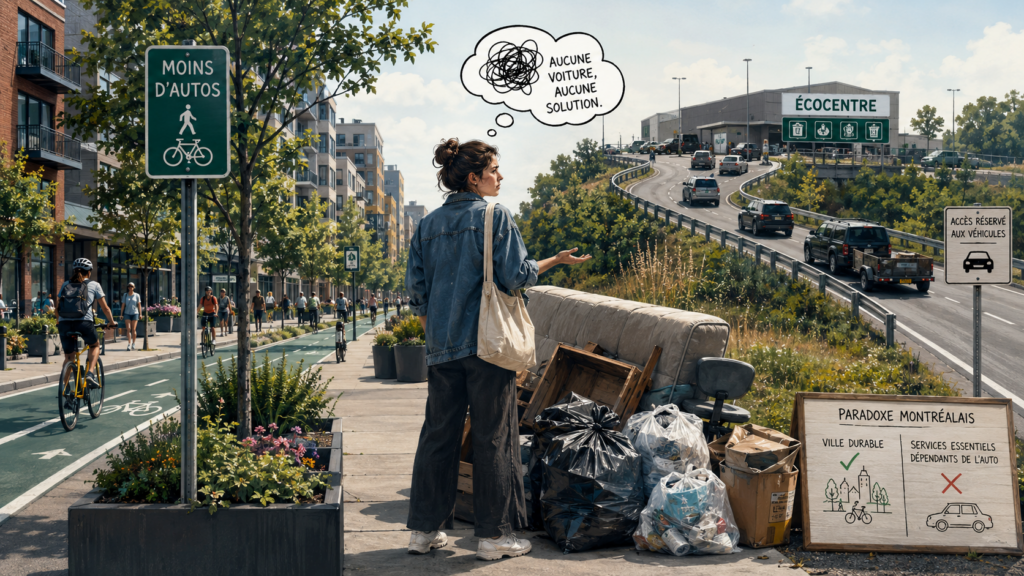
But a very concrete question arises in the field: how can a citizen without a car bring his or her waste, bulky items, hazardous materials or hard-to-transport objects to an ecocenter?
This question becomes even more important at a time when many motorized or local collection services are being reduced, relocated or concentrated in ecocentres. In theory, the city encourages more sober mobility. In practice, it transfers part of the logistical responsibility to citizens, often without offering them an equivalent solution when they don’t have access to a car.
This is not an operational detail. It’s a public policy paradox.
The heart of the paradox
The ecological transition is based on two messages that should reinforce each other:
- reduce car use;
- improve waste management.
The problem arises when the second strategy is still heavily dependent on the first.
When a local collection service is reduced or withdrawn, citizens are invited to go to the ecocenter. This logic works for part of the population: motorized households, people with flexible schedules, people able to transport heavy or bulky materials, citizens with access to a trailer, a family car or an available relative.
But it works much less well for :
– citizens without a car;
– the elderly;
– single-parent families;
– people with reduced mobility;
– low-income households;
– tenants in dense housing;
– citizens living alone;
– people working weekends or atypical schedules;
– citizens unable to transport heavy, dirty or hazardous materials on a bus or metro.
This is where the issue goes beyond simple waste management. It’s a question of accessibility, environmental equity and urban coherence.
A public utility should not assume that everyone owns a car
The ecocenter is an important tool. It diverts materials from landfill, promotes reuse, and recovers construction materials, household hazardous waste, furniture, electronics and other materials that shouldn’t end up in the garbage.
But the ecocenter remains primarily a voluntary drop-off model. In other words, the citizen must go there.
In a city that wants to reduce the role of the car, this logic needs to be rethought. If environmental services require the use of a personal vehicle, they run the risk of creating a structural contradiction: citizens are asked to drive less, but certain essential services are organized as if they were all driving.
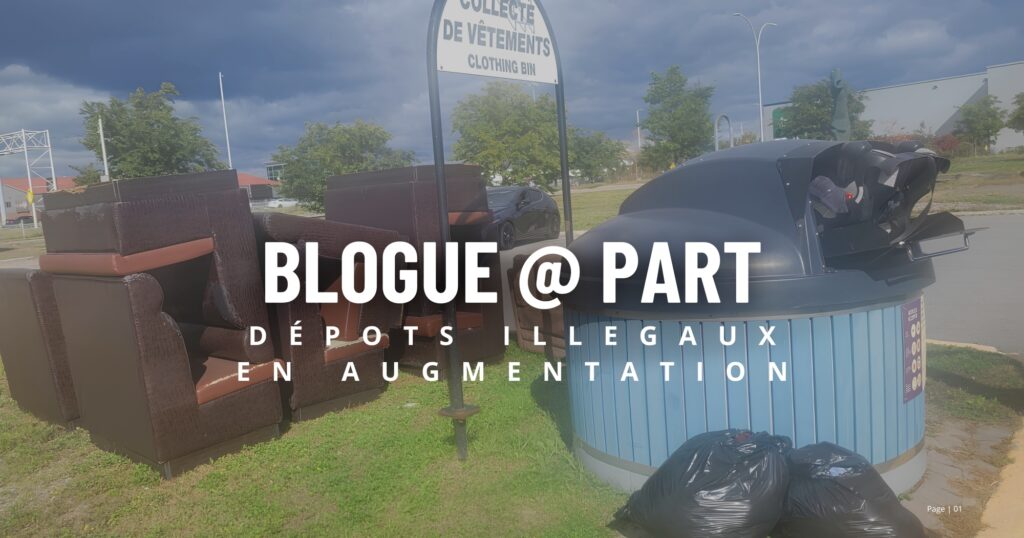
The likely outcome is predictable: motorized citizens continue to use ecocenters, while non-motorized citizens have to improvise. Some wait. Some accumulate. Some abandon objects in alleyways, near buildings, next to containers, on private property or around community facilities. Others drop off in the wrong place, not out of bad faith, but because there’s no realistic solution.
It’s not just a problem of civic behavior. Sometimes it’s a problem of service design.
On Mondays, everyone becomes a bit of a “citizen without a solution”.
The closure of ecocentres on Mondays during the summer also raises another issue. Even citizens with access to a car may find themselves without an immediate option when they are available to travel.
Monday is often a catch-up day after a weekend of cleaning, renovating, moving or sorting. If the ecocenter is closed at this time, materials remain in vehicles, driveways, garages, balconies or alleyways. The pressure doesn’t go away. It just moves.
This closure may seem minor from an internal management point of view, especially if it is the result of a ridership analysis. But from a citizen’s point of view, it takes away a strategic day from households already limited by availability, transport or physical capacity.
So the question isn’t just: how many citizens use the ecocenter on Mondays?
The real question is: which citizens are losing their only realistic window of access to service?
The end of certain local collections changes the nature of the problem
In 2026, the agglomeration of Montreal has announced the end of itinerant collections of household hazardous waste. Citizens are invited to bring these materials to ecocentres.
On paper, the solution is simple: go to the drop-off point.
In the field, it’s more complex. Household hazardous waste is not like other materials. Paint, solvents, batteries, oils, chemicals, aerosols, light bulbs and other sensitive materials should not be transported haphazardly, abandoned or thrown in the garbage.
The more distant the official solution becomes, the greater the risk that some citizens will choose a workaround: wait too long, drop off in the wrong place, dispose of with ordinary waste or abandon near an unsuitable collection point.
Again, it’s not just a question of information. It’s a question of actual ability to perform the right behavior.
Active transportation can’t carry everything
Walking and cycling are essential to the city of tomorrow. They reduce emissions, improve public health, free up urban space and make neighborhoods more human.
But active transportation has its limits. It is excellent for transporting a person, a bag, a small errand or a daily trip. It becomes much less suitable when you need to transport :
– several paint cans;
– old furniture;
– renovation materials;
– heavy electronics;
– bulky donation boxes;
– accumulated textile bags;
– dirty, sharp or difficult-to-handle objects.
The ecological transition must therefore not pit active transport and residual logistics against each other. It must integrate them intelligently.
A city can very well reduce the role of the solo car while maintaining collective, mutualized, planned and efficient motorized services for matters that really require specialized transport.
Fewer individual cars should not mean fewer collection services. On the contrary, fewer cars should lead to more shared solutions.
The risk: shifting costs from the city to citizens, NPOs and private land
When a city reduces a service without providing a local alternative, the costs don’t disappear. They simply change hands.
These costs can be transferred to :
– citizens, who have to rent a vehicle, ask for help or waste time;
– building owners, who manage illegal dumping;
– janitors and home managers, who inherit improperly deposited materials;
– NPOs and social economy enterprises, whose facilities become improvised drop-off points;
– shopkeepers, who suffer from dumping on their premises;
– municipal clean-up teams, who have to correct the situation after the fact;
– the environment, when materials end up in the wrong place.
This is particularly important for an organization like Fondation La Collecte. Our mission is to transform clothing donations into social impact, notably by supporting Big Brothers Big Sisters of Greater Montreal. We are not a municipal waste management service. We are a social economy enterprise that collects clothing and accepted items to generate community, environmental and social value.
When citizens lack accessible options for disposing of their materials, donation facilities can unwittingly become dumping grounds. Littering around collection points doesn’t just harm a site’s image. They increase operating costs, reduce the quality of recovered donations, create safety issues and divert resources that should serve the social mission.
The important nuance: we must not defend more trucks everywhere, all the time.
It would be too simple to respond to this paradox by saying that all collections should be returned to the way they were before.
This is not necessarily the best solution.
Good public policy must avoid two mistakes:
– increasing the number of trucks without optimization;
– reducing services without alternative solutions.
The right balance lies somewhere in between.
The city should reduce unnecessary trips, but reinforce collective motorized services where they replace hundreds of individual trips. A planned collection by sector, a collection by appointment, a temporary mobile point or a proximity partnership can be more effective than a succession of individual trips to an ecocenter.
In other words, the problem isn’t the truck. The problem is the poorly planned, redundant or inefficient truck.
A well-filled, well-routed collection truck, used to avoid dozens of individual car journeys, can be a more coherent climate solution than a model where each citizen has to travel separately.
What the city should measure before reducing a service
Before withdrawing or reducing a collection, more than the direct cost of the service should be evaluated.
We need to measure :
– the motorization rate of affected households;
– the actual distance between households and the nearest ecocenter;
– public transit access with the targeted materials;
– the physical capacity of citizens to transport these materials;
– peak periods such as spring, moving, renovations and weekends;
– the risk of illegal dumping;
– the cost of cleaning up after abandonment;
– the impact on NPOs, businesses and private property owners;
– the emissions generated by individual trips to ecocentres;
– the loss of participation by non-motorized citizens.
Without this comprehensive analysis, we run the risk of making administrative savings that result in higher social, environmental and operational costs elsewhere.
Possible solutions: from fixed ecocenters to local ecosystems
The solution is not to reject ecocentres. They are necessary. But they should not be the only pillar of access for difficult residual materials.
A more coherent strategy could include :
1. Mobile mini-ecocentres for each neighborhood
Temporary points, announced in advance, set up in places accessible on foot, by bike or by public transport: municipal parking lots, libraries, arenas, public markets, schools, community centers.
2. On-demand collections for targeted audiences
A service reserved or prioritized for people without cars, the elderly, vulnerable households, people with reduced mobility or high-density buildings.
3. Local depot days in spring and during moves
The critical moments are well known: spring cleaning, end of session, June and July moves, summer renovation, return of the holidays. We need to concentrate our solutions where citizen pressure is strongest.
4. Partnerships with NPOs, but with real funding
Community organizations and social economy enterprises can be part of the solution, but not for free or at the expense of their mission. A partnership must include guidelines, funding, clear responsibilities, signage, management of refused materials and protection against illegal dumping.
5. Better signage of accepted and rejected materials
Some of the problematic deposits stem from a lack of clarity. Citizens need to know exactly where to go, what to bring, when to bring it and what not to drop off at a donation point.
6. A comparative carbon calculation
The city should compare the emissions of a pooled collection with those of hundreds of individual trips to ecocentres. This type of analysis would make it possible to distinguish between unnecessary motorized services and motorized services that really make a difference.
7. A universal service rationale
An environmental service is not fully effective if it is only accessible to motorized citizens. Accessibility must become a performance criterion in the same way as tonnage, cost and recovery rate.
Fondation La Collecte’s position
Fondation La Collecte believes in waste reduction, reuse, the circular economy and a city less dependent on the automobile. But this transition must be coherent, humane and practical.
A citizen should not be penalized for doing exactly what the city encourages: living without a car.
A sustainable mobility policy must be accompanied by a sustainable proximity policy. Otherwise, we create a contradiction: we invite citizens to reduce their dependence on the car, then we ask them to use a car to participate properly in the management of residual materials.
The ecological transition won’t succeed on targets alone. It will succeed through services that are accessible, well-designed, well-financed and adapted to the realities of households.
Conclusion: fewer individual cars, more collective solutions
The real question is not whether Montreal should reduce the role of the automobile. It must.
The real question is: how can we ensure that this reduction doesn’t create a city where only motorized citizens can play a full part in good environmental practices?
The ecocenter is an important part of the system, but it can’t be the only answer. To be coherent, the city must recognize that waste management is also a question of mobility, equity and service design.
Fewer cars should never mean less access.
Fewer cars should mean more collective solutions, more proximity, more pooling and more operational intelligence.
Only then can the ecological transition be ambitious, credible and truly inclusive.
Sources consulted and mentioned
– Ville de Montréal, Climate Plan 2020-2030.
– Ville de Montréal, official page on ecocentres, updated May 7, 2026.
– Ville de Montréal, Mercier-Hochelaga-Maisonneuve announcement on the end of local collection of household hazardous waste, April 14, 2026.
– City of Westmount, announcement on the end of mobile household hazardous waste collection in the Greater Montreal area, April 7, 2026.
– Ville de Pointe-Claire, notice of changes to collection services offered by the agglomeration of Montreal, February 9, 2026.
– Government of Quebec, Sustainable Mobility Policy 2030.
– INSPQ, Sustainable mobility policy: public health perspectives.
– INSPQ, mobility measures for seniors, 2023.
– ARTM, Enquête métropolitaine 2023, Perspectives mobilité.
– RECYC-QUÉBEC, resources on sustainable waste management and ecocenters.
– La Presse, article of April 21, 2026 on Montreal’s clean sweep.
– La Presse, April 27, 2026 article on the end of local hazardous waste collection.
Management: Benoit Tessier
Editing assisted by IA
Fondation La Collecte